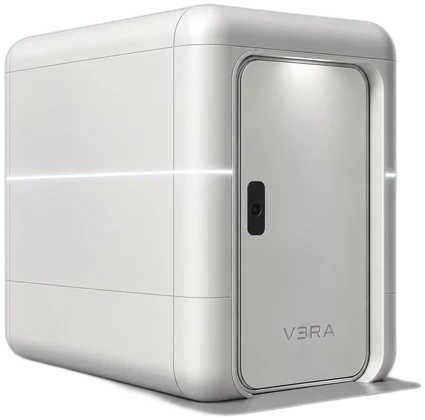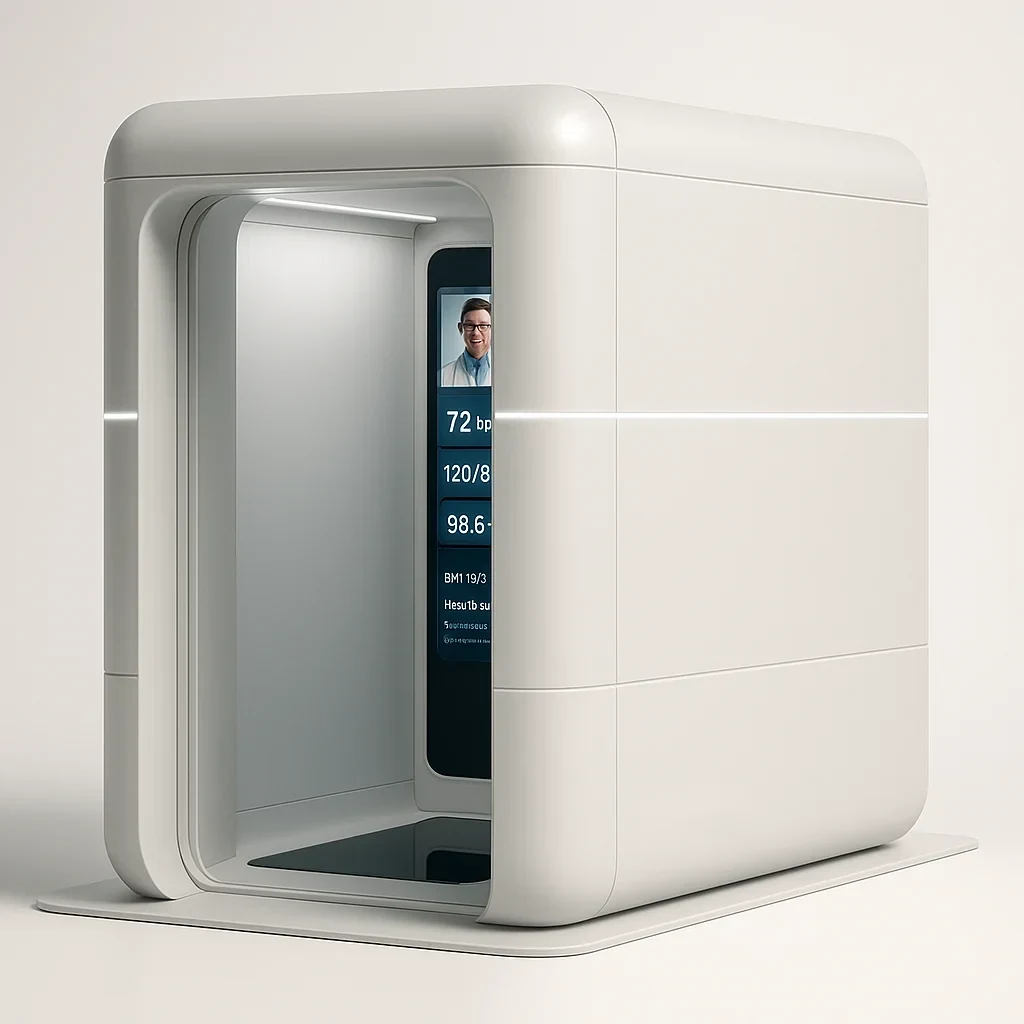
Design render of the V3ra Intake Pod: a white enclosure with a lit door edge and an interior screen showing live
                vitals beside a physician on video. The enclosure is in development and has not been manufactured.
Render · enclosure in development
Intake Pod

Walk up. Step on.
Be seen.

Vitals and symptoms, captured at the door. A physician on the other end.

Request a demo Runs on VAS, the system underneath every V3ra product

Works with the record you already run

The sequence

Arrival to physician, in one sequence.

A fixed order. The patient is never asked to choose their way through it, and never asked to read a form. The sequence is built and running today on a screen, with the vitals taken without touching the patient, rather than inside the enclosure it is designed for.

V3ra · Intake Pod1 of 6
WelcomeHere is what happens next.
  1. 1Step on the scale
  2. 2We read your vitals
  3. 3Tell us what brought you in
  4. 4A physician joins you
Start
Next · ScaleIllustrative
1Arrival · ScreenWelcome

Plain language: what is about to happen and how long it takes. Nothing is captured yet.
V3ra · Intake Pod2 of 6
Please stand still82.4kgIntegrated scale · reading steadyReading held
Next · VitalsIllustrative
2Arrival · DeviceScale

Weight first, because it needs the patient to stand still, and standing still is what the rest of the capture needs.

V3ra · Intake Pod3 of 6
Reading devices
Blood pressure128/82
Heart rate88
SpO₂98%
Temperature98.6°F
Connected devices · no transcription
Next · IntakeIllustrative
3Arrival · DeviceVitals

Pressure, rate, saturation and temperature, taken without touching the patient. No transcription step to get wrong.

V3ra · Intake Pod4 of 6
IntakeWhat brought you in today?Pressure in my chest when I climb stairs. It started a few days ago.Does the pressure spread anywhere, like your arm or jaw?No, it stays in the middle.Listening
Next · TriageIllustrative
4Intake and hand-off · VoiceIntake

The patient says what brought them in, out loud. Follow-ups are asked one at a time, and only the ones the answers so far make relevant.

V3ra · Intake Pod5 of 6
Triaging
  • Acuity assigned by Pulse
  • Differential assembled, with citations
  • Coding derived by Sync
You can watch each step as it happens
Next · TelehealthIllustrative
5Intake and hand-off · TriageTriage

The pod triages the patient on its own with Pulse: acuity assigned, the differential assembled with its citations, the coding derived by Sync. The patient sees the work happen rather than a blank screen.

V3ra · Intake Pod6 of 6
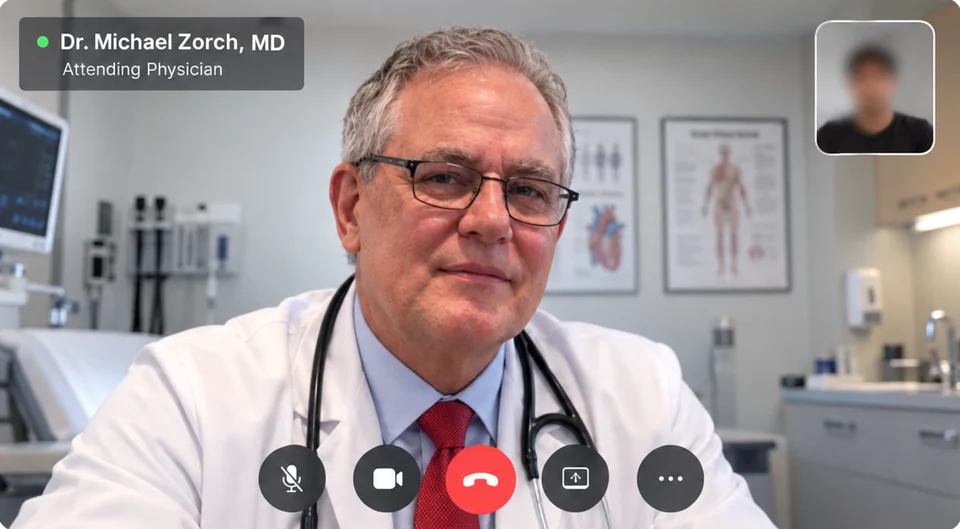
The physician on the video call, the patient’s own view in the corner
128/8288 bpm98%3 cited
Your vitals and what you told us are already with them
With the physicianIllustrative
6Intake and hand-off · VideoTelehealth

A physician joins already holding the vitals, the narrative and the cited draft. The encounter starts where a normal one reaches ten minutes in.

  1. 1Welcome
  2. 2Scale
  3. 3Vitals
  4. 4Intake
  5. 5Triage
  6. 6Telehealth
The six phases, runningA screen recording of the flow that runs today, captioned as software running on a screen while the enclosure is in development.Muted and captioned, never autoplaying with sound. The real product, never stock footage.

No front desk.
No forms.

Weight, vitals and the patient’s own account, captured autonomously at the door.

Forms to read

The patient answers out loud. Nothing to fill in.

Staff steps

No front-desk step, and no staff training.

Phases, in a fixed order

Welcome, scale, vitals, intake, triage, telehealth.

Record out

Read by Clinical Intelligence and Chart Audit.

0 forms to read0 staff steps6 phases1 record out
Missing data

A measurement we could not take stays missing.

The same encounter, with one reading that could not be taken, recorded two ways.

Filled with a default

Looks complete, and is not

A defaulted value is indistinguishable downstream from a measured one, and would later be scored as though it had been documented.

The V3ra record

Empty, flagged and counted

If a device does not connect or a patient declines, the field stays empty and the count travels with the encounter to everyone who reads it.

One record out

Nothing re-entered.

The same record, carried forward, is why an audit months later can point at the line that produced a finding. The line has been there since the door.

Encounter recordOne record · written at the door
1Weight82.4 kgDoor
2Blood pressure128/82Door
3Heart rate88Door
4SpO₂98%Door
5Chief complaintChest pressure on exertionDoor
6Patient’s words“Pressure in my chest when I climb stairs.”Door
7DifferentialAssembled, 3 citedCI
8CodingDerived, a draftCI
9DecisionAccepted · Dr. Michael Zorch · 10:42MD
10FindingRests on line 5, written at the doorAudit
Nothing re-enteredIllustrative
At the doorThe patient

Says it once. Everything after reads the same record.

During · encounter openClinical Intelligence

Scores it, builds the cited differential and derives the coding while the encounter is still open and still correctable.

How the analysis works
During · telehealthThe physician

Works from it on the telehealth leg. Their accept, override or defer is written back to the same record, with their name and the time.

How the record is kept
After · claim submittedChart Audit

Reads the completed encounter back against what was billed, in both directions, once the claim has gone out.

What it finds

One record, from the door to the audit.

Revenue integrity
a CFO can trace

The case for the pod is written in what your finance office already tracks: documentation that starts complete, coding derived at the door, and a record Chart Audit can read back line by line.

Nothing here

Blood pressure128/82Cuff
Heart rate88Sensor
SpO₂98%Oximeter
Weight82.4 kgIntegrated scale
Temperature98.6°FThermometer
Chief complaintChest pressure on exertionSaid at intake
Patient’s words“Pressure in my chest when I climb stairs.”Verbatim
AcuityAssignedPulse
Differential3 citedClinical Intelligence
CodingA draftSync, while open
ClaimOne encounter, from the doorIllustrative
Emergency visitLevel set by the documentation
DiagnosisChest pain, as the physician accepted it
Vital signsFive readings, documented
CodesDrafted while the encounter was open
Typed by hand0
The claimas your finance office receives it
Derivedwhile the encounter was open
Statedin the patient’s own words
Measuredoff a device, never typed
Typed by handno field, ever
One claim, as it leaves.

Every line on it rests on something in the record. Keep scrolling and lift it.

Underneath, the record.

Each field sits in the layer it came from: derived, stated or measured. The bottom layer is for anything typed by hand.

The visit’s level

rests on the acuity Pulse assigned at the door, the complaint in the patient’s own words, and 128/82 off the cuff.

The diagnosis

rests on a differential with three cited sources, the patient’s own sentence, and 98% off the oximeter.

The codes

were drafted by Sync while the encounter was open, from the same complaint and the same readings. Nothing was copied across.

Typed by hand: none.

The bottom layer stays empty. No field under this claim was keyed in by anyone.

One record to the claim.

The work that happened is the work the record carries, so the claim can be read back against it months later.

10fields under the claim
0typed by hand
1record to the claim

What runs now, and what is still being built.

A new kind of product should say plainly which parts exist.

Runs today.

The pod’s screen
Autonomous triage
Telehealth hand-off
The single record

Being built.

A design render of the intake pod, closed

The enclosureEvery picture of it is a render.

Before a pod goes in the waiting room.

What comes up before a pod is sited, answered plainly.

The visit

What does the patient do?

Steps in, stands on the scale, answers out loud. No forms.

What does it measure?

Weight, blood pressure, heart rate, SpO₂ and temperature, all from devices.

What if a device fails?

The field stays empty and flagged. Never a default.

The decision

Does the pod triage?

Yes, on its own, with Pulse.

Who makes the final call?

The physician on telehealth, who can accept or override.

What does setup involve?

Siting the pod and the telehealth link, walked through in person.

The pod triages on its own.
A physician on the other end makes the final call.

Plainly

What the pod is not.

Autonomous triage, with a physician on the other end.

  • It does not tell the patient a diagnosis.

    No diagnosis is spoken aloud by a machine. The triage and the cited differential go to the physician.

  • It does not replace a nurse.

    It replaces the typing, the clipboard and the queue in front of the desk.

  • It does not invent a measurement.

    A vital it could not take is reported as missing, and counted.

  • It does not finish without a physician.

    Every sequence ends on telehealth, where a physician can accept or override the triage.

See the pod in your own waiting room.

Start with a conversation about your setting.

Request a demo