
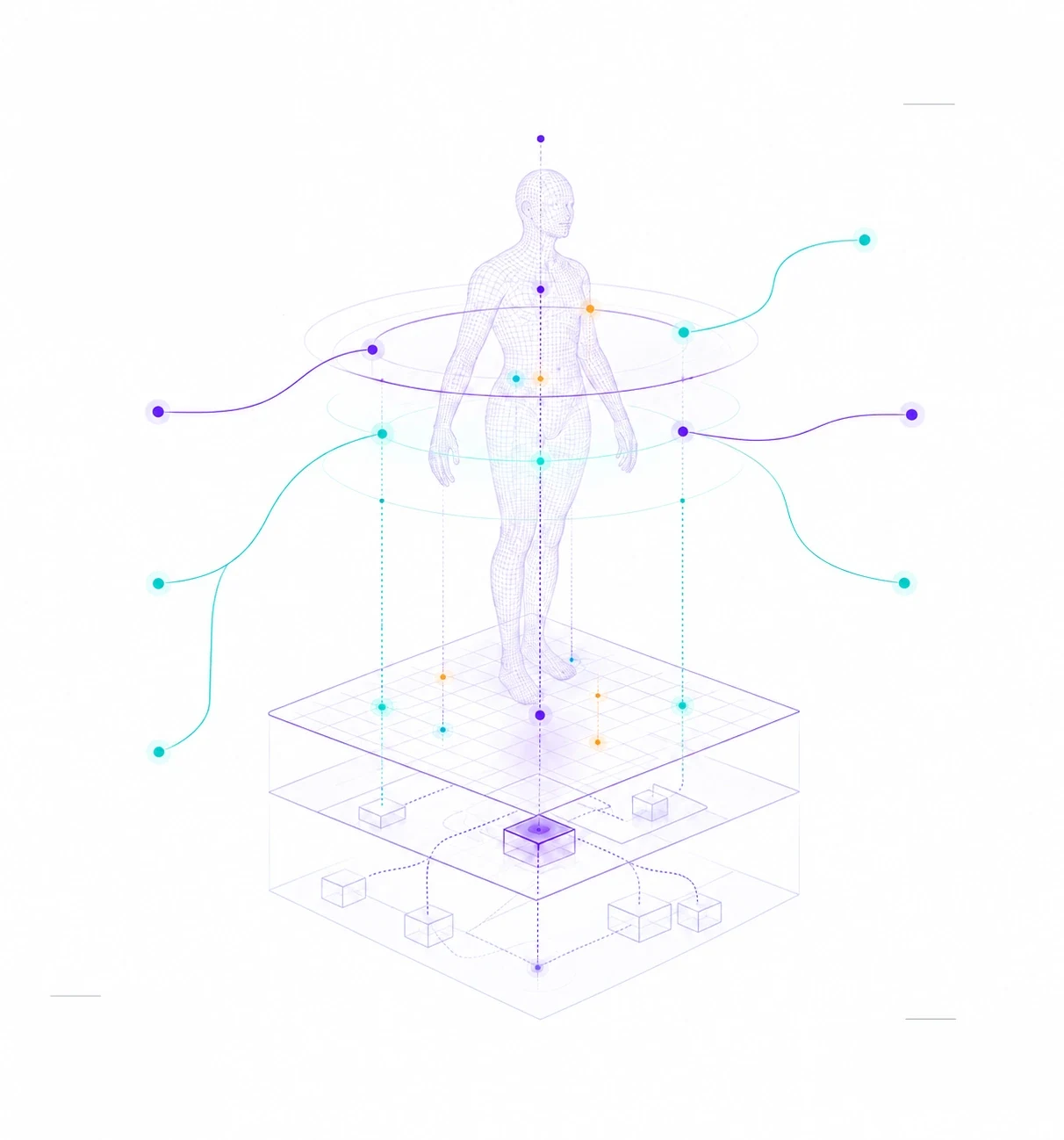
What it actually does
Always with you. Working for a healthier tomorrow.
It senses what the person’s own instruments report, connects it to what came before, learns what normal looks like for them, and keeps all of it under their control. None of that requires the person to do anything.
SenseConnectLearnProtect
The person is the centre of it. Everything else (the layer that carries the signal, the substrate underneath) exists to keep them there.
Tap Oren to meet him
Try the Agent
Meet Oren.
Oren is the Agent you live with: one orb on a calm screen, there when you need him, talked to rather than tapped through. Cards appear only when something is easier to see than to hear. He is not a doctor. He notices changes against your own normal, explains what they mean, and tells you when it is worth calling someone.
This is the real app, running here on sample data for Maya, who does not exist. Every card works: tap around inside it. The Agent runs today on one phone and is not available yet.
Exploring a card pauses the tour. Next card picks it up again.
During the encounter1 / 6
Everything you can see here is what was written down.
The patient goes home2 / 6
The readings stop being taken. Nothing about the person stopped happening.
Days3 / 6
Sleep, appetite, whether the medication was actually taken.
Months4 / 6
Whether the thing that was supposed to improve actually improved.
The next encounter5 / 6
A room resumes, and the line arrives carrying what it gathered.
Years6 / 6
Two lit places, a long dark between them, and one line across it.
The whole point
The encounter ends. The Agent doesn’t.
Continuity is the entire value, and no system inside a hospital can offer it, because a hospital system stops at the door.
Everything you can see is the record.
The room, the bed, the monitor, the light on the floor. Watch what happens to all of it at the door, and watch what happens to the line.
The readings stopped. The person didn’t.
That is every clinical system in use today. Days go by, and the only thing still adding anything is the one that went home too.
Months of it.
Recovery, adherence, decline. None of it is written down anywhere, and all of it is the part that decides how the next encounter goes.
It hands back what it was given.
The record resumes. Nobody starts from scratch, because the clinician begins from a history rather than a blank page.
And then it keeps going.
The value is not what it noticed this week. It is what it can see because it never left.
The problem it exists for
We are blind to our own bodies.
You feel a pain and you do not know what it is. The information that would answer the question is scattered across every clinician who has ever seen you, and no single one of them holds all of it.
The record is written during the visit and then stops. What happens in the months on either side of it is unrecorded and unseen.
What that requires
Owned by the patient, in the architecture.
The Agent is only possible when the patient is the legal and cryptographic owner of what it holds, from the first line of code forward.
Data leaves the patient’s control only at the patient’s instruction, in a form the patient understands, and can be revoked at any time. The same hash-chained record and the same kill switches a hospital can inspect at a pilot are the ones that govern this.
It is worth saying what the failure would look like, because it is the obvious one. An Agent that treats the person as a data subject rather than a principal, and lets the record flow to whoever pays for it, would be cheaper to build and faster to ship. We would rather state the line here, plainly, so there is something to hold us to.
What it does not replace
The clinician does not disappear.
The Agent observes, carries continuity and prepares context. It reaches a line it will not cross, and hands over what it has to the person whose decision it is.
What gets handed over is recorded, and what the clinician does with it is recorded too. That is the whole of the arrangement.
What it is
An Agent is not a device.
It is software that holds one person’s health picture over time, it answers to that person alone, and it is present for the part of their life no record has ever reached. Three things, and the hardware is not one of them.

01
The intelligence is the constant.
It runs on the same substrate as the clinical system: the same audit trail, the same deterministic failsafes. What you can hold in your hand is only where it surfaces.
02
The patient is the principal.
Insurers, employers, pharmaceutical companies, researchers and hospitals are all counterparties. Every reach stops at the same boundary, and nothing crosses it without the patient saying so.
03
The ordinary days nobody writes down.
Two visits a year apart are what the record holds. Everything between them happened to a person and to no system.
One intelligence, answering to one person, present for all of it.
The patient-side V3ra is not a separate product. It is V3ra running in a different context.
How it becomes present
One Agent. Many ways to be present.
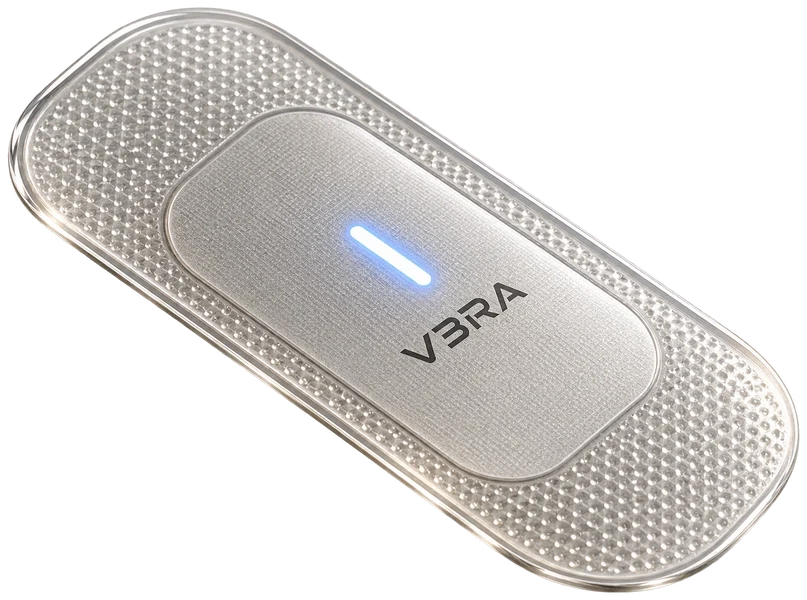
The hardware is an interface, not the product. Each form is only how the same intelligence happens to be in the room, and the intelligence is the part that does not change.
OrbitalConcept · not built
StripConcept · not built
The intelligence is the constant. The object is incidental.
Possible interfaces. Forms shown are conceptual. None of them is the Agent.
What is real today
It runs today. On a phone.
One phone, one user, which is the whole of it. Everything else on this page is either a render or a direction, and the three below say which is which.
There is no fourth row. Nothing about the Agent is available to buy, and nothing above is a forecast with a date behind it.
What it is not
Said plainly, and not softened.
Every page on this site carries one of these. It is the section we would want to read first if we were the ones being sold to.
Not a diagnosisWhere something looks like it matters, the
output is a reason to speak to a clinician, never a substitute for having done so.
Not a monitorNot a medical device, not cleared as one. What
it reads today comes from instruments the person already owns.
Not for saleNo product, no waiting list, no price. There is
nothing to buy and will not be for some time.
Not a data businessThe record is not the asset. This is the
commitment most easily broken quietly, which is why it is written down.
The form changes. The Agent doesn’t.
There is nothing here to buy yet. The way into V3ra today is the clinical side, and the lowest-friction place to start is an audit of charts you have already billed, which needs no integration and changes nobody’s workflow.